🚀 What Is the International Space Station (ISS)? – Part 1
The International Space Station (ISS) is a modular space station built and operated as a multinational project.
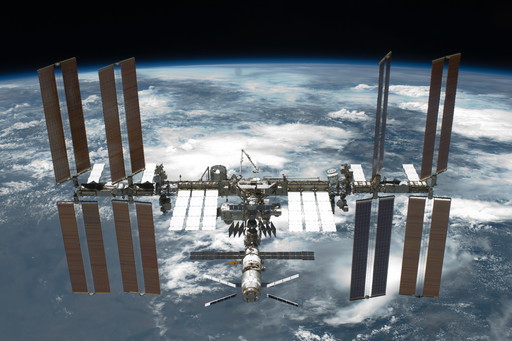
It is a joint project involving five space agencies:
- NASA (United States)
- Roscosmos (Russia)
- JAXA (Japan)
- ESA (Europe)
- CSA (Canada)
The ISS is not just a satellite.
It functions as a microgravity laboratory, supporting research in:
- Space biology
- Astronomy
- Meteorology
- Physics
🌍 Orbiting Just Above the Earth
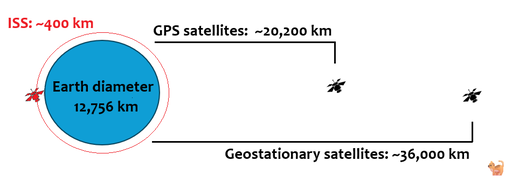
The ISS operates in Low Earth Orbit (LEO) at an altitude of:
Approximately 400 km above Earth
It travels at an incredible speed of:
About 7.7 km per second
At this speed, it completes one orbit around the Earth in roughly 90 minutes.
This altitude is carefully chosen:
- Too high → increased radiation exposure (Van Allen belts)
- Too low → atmospheric drag would pull it down
To maintain its orbit, the ISS performs periodic reboost maneuvers.
🛰️ How Close Is It, Really?
Recently, Starlink has been gaining significant attention. It also operates in Low Earth Orbit (LEO), at an altitude of around 550 km. Today, approximately 10,000 satellites are in operation, forming a vast constellation around the Earth.
For comparison:
👉 Geostationary satellites: ~36,000 km
👉 GPS satellites: ~20,200 km
The ISS, by contrast, is only:
👉 ~400 km above Earth
This huge difference explains why the ISS can sometimes be seen with the naked eye 🌏
👨🚀 A Place Where Humans Live
The ISS is continuously inhabited by:
6 to 7 astronauts
Surprisingly, it even has:
Internet connectivity
In other words, the ISS is a human outpost in space
📡 The ISS Transmits Radio Signals
In addition to dedicated communication systems, the ISS also operates on amateur radio frequencies.
📡 ISS Amateur Radio Frequencies
- Downlink (receive): 145.800 MHz (FM)
- Uplink (transmit): 144.490 MHz (FM)
Other operations include:
- Digipeater: 145.825 MHz
- SSTV (image transmission): 437.550 MHz
- UHF band: 437.800 MHz (used in some cases)
🚨 The Challenge: Doppler Shift
The ISS moves at about 7.7 km/s, which causes a shift in the received frequency.
👉 This is known as the Doppler shift
In practice, this means you need to adjust:
👉 145.800 MHz ±5 to 10 kHz
to properly receive signals during a pass.
🐈 This Project
In this series, I will attempt to receive signals from the ISS using a very minimal setup:
- Raspberry Pi Zero 2 W
- RTL-SDR dongle
- Telescopic dipole antenna
Can we capture voices from 400 km above Earth.
That is the challenge.